Day 1 features fine Pre-Columbian and Spanish Colonial art; Day 2 features Native American, Tribal, African, Egyptian, Greek, Roman and Near Eastern antiquities
BOULDER, CO, UNITED STATES, June 4, 2026 /EINPresswire.com/ — Artemis Fine Arts and Arte Primitivo will host a meticulously-curated online-only auction on June 11-12, marking the third time the two auction powerhouses have joined forces to produce an event that compatibly showcases the best of their respective consignments. In their debut joint auction held in February, strong international bidding boosted the total to nearly $1.5 million.
Day One, on Thursday, June 11, will showcase fine Pre-Columbian and Spanish Colonial art, while Day Two brings together Native American, Tribal, African, Egyptian, Greek, Roman and Near Eastern antiquities, Asian art, fine art, fossils and more. The auction is now open for bidding through Artemis Fine Arts’ dedicated online platform, as well as Arte Primitivo’s online bidding system, plus LiveAuctioneers and Invaluable and, for the first time, Drouot, the internationally-renowned Paris-based company known for its association with elite European auction houses.
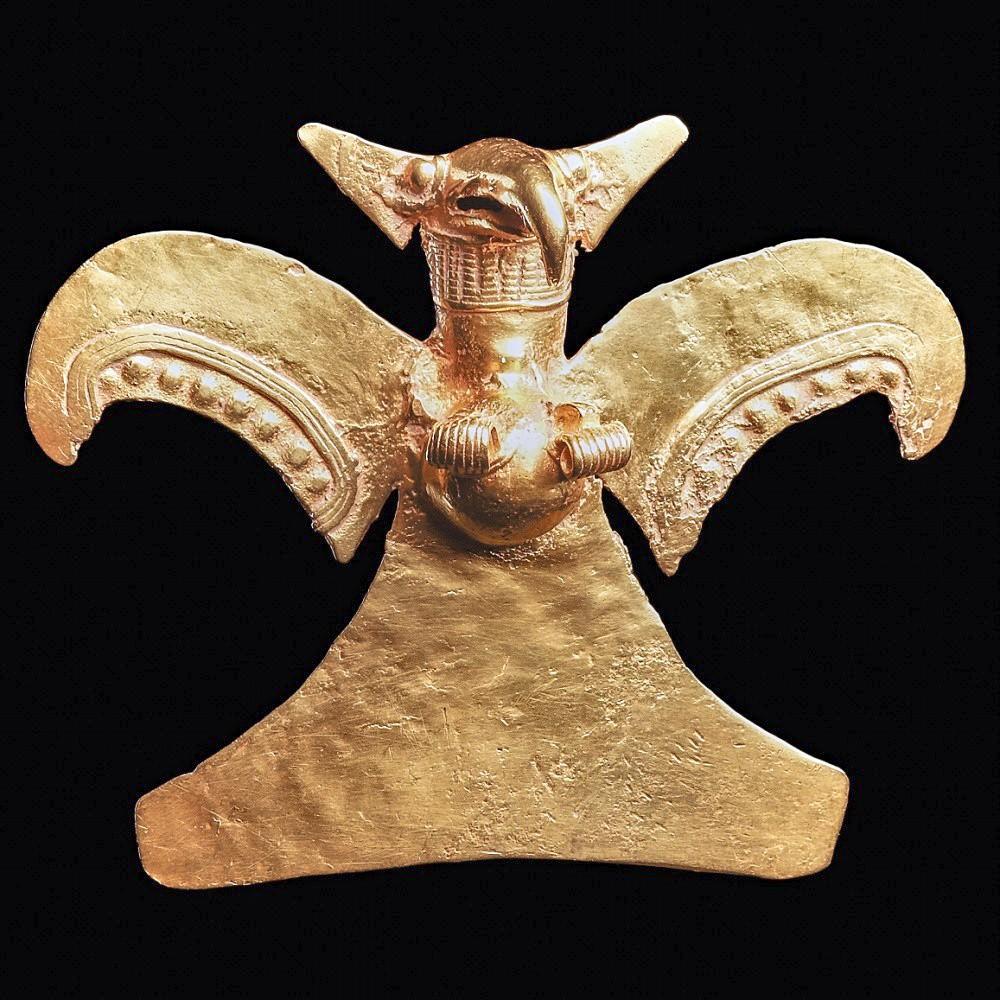
A potential candidate for top-lot honors in the opening session, a large and heavy museum-exhibited Diquis gold pendant, a classic depiction of a “Harpy Eagle,” was crafted circa 1200-1500 CE in Panama. Estimate: $60,000-$90,000. Like many of the items to follow, it is from the Pre-Columbian period.
A beautiful gold kero, or drinking vessel (circa 750-1000 CE), having a relief decoration depicting two opposing shamanic dignitaries holding a monkey in both raised hands, has an estimate of $15,000-$22,500; while a finely-cast and realistic International-Veraguas gold pendant in the form of a grimacing shark, made circa 800-1500 CE on the Panama-Colombia border, is expected to realize $36,000-$54,000.
A monumental Aztec Empire three-piece natural buff color pottery sculpture depicting the god Mictlantecuhtli, the Aztec god of death, circa 1000-1450 CE, should fetch $29,000-$43,500. Also, an Aztec Empire (Tenochtitlan, circa 1400-1533 CE) matching pair of fine black ceramic ear ornaments of floral design, each one depicting two perched birds, carries a pre-sale estimate of $5,000-$7,500.
Lots 90 and 91 have identical individual estimates of $25,000-$37,500. One is a large, carved grey volcanic stone brazier depicting the aged deity Huehueteotl, the God of Fire, from the Teotihuacan Classic period (circa 450-650 CE). The other is a fine pottery Totonac culture Veracruz sitting dignitary with legs crossed under a long, wrapped skirt with a large bow at the front of its belted waist. It dates to circa 1450 CE.
Lots 113 and 115 have identical estimates of $20,000-$30,000 each. The first is a carved white marble tapered cylindrical vase depicting the Maya god Chac (of rain, thunder and lightning), made in the Ulua Valley region of Honduras, circa 600-800 CE. The second is a polychrome-decorated pottery vase from the Maya regions, circa 500-800 CE, depicting four beautifully painted gods.
A large Pre-Columbian royal Sican silver sheet copper mask from the north coast of the Lambayeque Valley in Peru, with drop-shaped eyes, circa 800-1200 CE, has an estimate of $19,000-$28,500. Also, a high-grade silver (95.3 percent) kero from Chimu in north central Peru, depicting a stylized human head with repousse features, circa 1100-1400 CE, should breeze to $6,000-$9,000.
Day One also features Spanish Colonial items, mostly from the private collection of Samuel Saunders of Nogales, Arizona. He is a partner of Holler & Saunders, Ltd., founded in 1979 and widely regarded as one of the preeminent authorities in Spanish Colonial and Mexican folk art. The following lots from his collection are included in the auction.:
• An exceptionally rare and scholarly Cusco School (circa 1720-1780 CE) portable devotional oratory (oratorial portratil), the domestic equivalent of the great Baroque altarpieces that filled Andean churches in the 17th/18th centuries. Estimate: $7,000-$10,500
• A 19th-century large silver (95 percent pure) votive/santo crown in the Spanish Colonial ecclesiastical tradition, from Bolivia or Peru, made to adorn the head of a church altar figure of the Virgin Mary or a major saint. Estimate: $4,000-$6,000
• A polychrome and gessoed wood bulto (statue) of Saint Michael the Archangel, made in Mexico circa 1700-1799, 22.1 inches tall, with glass eyes and animated with kinetic energy. Estimate: $6,000-$9,000
• A dramatic and finely-worked example of a so-called “Barbone” mask, a silver visage that merges European physiognomy with fantastical animal imagery, made in Guerrero, Mexico circa 1900-1949 CE. Estimate: $4,000-$6,000
On to Day 2, where 339 lots dedicated to Native American, Tribal, Antiquities and Fossils will be led by a monumental circa 1368-1644 CE Chinese Ming Dynasty wood and stucco head of a Buddhist guardian deity. The 13¼-inch-tall piece commands attention through the sheer force of its physiognomy. The estimate is $100,000-$150,000.
Another lot to watch is an Eastern Mediterranean early Imperial period (circa 1st-2nd century CE) cast-bronze statuette of the winged goddess Victory (or Nike), depicted standing atop a pedestal drum-type base, her arms outstretched and holding a laurel wreath. Estimate: $56,000-$84,000
A Native American (Mississippian) Caddoan Late Horizon trophy head vessel of red-on-buff terracotta, circa 700-900 CE, hand-built in the Type A form, 9½ inches tall, should coast to $24,000-$36,000; while a hand-carved stone effigy pipe made by the Hopewell Indians in the northeastern United States during the Middle Woodland period, circa 200-900 CE, is expected to reach $9,000-$13,000.
A rare Native American redware vessel modeled as an ithyphallic seated male figure adorned with paired shell and turquoise earrings, from the Mogollon culture, San Francisco phase, circa 900-1100 CE, has an estimate of $17,000-$25,000. Also, a large Pre-Columbian polychrome jar from Casas Grandes in northern Mexico, showing a paired Avanyu and stick figure, hand-built by coiling and scraping, should change hands for $10,000-$15,000.
A rare Native American Mimbres fishbowl in a checkered pattern, from the Anasazi Peoples of New Mexico, circa 950-1150 CE, features a painted interior design of a stylized fish. It should net $3,400-$5,100. Also, a large red-brown Gila polychrome ceramic bowl crafted in Salado circa 1300-1450 CE, decorated in the center of the interior with a large stylized horny toad, is expected to achieve $2,500-$3,750.
An important pair of Maori Whakawae door jambs produced in New Zealand in the 19th century are carved side uprights of a doorway or window opening. The 54-inch-tall architectural pieces are carved with three conjoined ancestral figures having naturalistic bodies and wheku faces. They were once exhibited at the Pitts-River Museum in Oxford, UK, and were previously sold at auction by Sotheby’s in 1976. Estimate: $30,000-$45,000
A fine 8-inch blue-green glazed faience pottery ushabti made in Egypt during the reign of Psamtik III (born Meri-Neith), dating to the Late period at the end of the 26th-27th dynasty, circa-520 BCE, shows Psamtik standing on a trapezoidal base. This impressive piece could command $30,000-$45,000; while an important Egyptian solid cast silver ring with a cartouche of King Akhenaten during his reign from 1353-1336 BCE, carries an estimate of $10,500.
An assemblage of Japanese samurai armor elements dating from Muromachi to early Edo, circa 1481-1640 CE, the elements tightly packed in the original yoroibitsu storage chest, should bring $20,000-$30,000. Also, a Japanese katana from the Edo period, circa 1866-1899 CE, is signed Sukesada on the nakago (or tang). It is accompanied by original World War II surrender documentation and is expected to find a new home for $3,000-$4,500.
An 18½-inch-tall carved Greco-Roman limestone frieze fragment depicting Persephone abducted by Hades, with Aramaic script, Magna Graecia, circa 340 BCE-200 CE, has a pre-sale estimate of $12,000-$18,000. Also, a fantastic ancient Near East Neo-Babylonian Dynasty clay tablet, produced during the reign of Nebuchadnezzar II, circa 604-581 BCE, and stamped with a dedication to the most famous of all the Kings of Babylon, is expected to reach $9,000-$13,500.
The rest of the Day Two session features an eclectic mix of outside-the-box items that demand attention. A few examples include:
• A rare fossilized skull of a prehistoric Nimravus, a false saber-toothed cat in the Nimravidae family, circa 31,000,000-24,000,000 BCE, discovered in Shannon County, North Dakota. Estimate: $30,000-$45,000
• A rare and important royal charter on vellum from the reign of King Henry III of England, dated March 1, (circa) 1264 CE, bearing the Great Seal of Henry III in dark green wax, attached by a multicolored braided silk cord. Estimate: $20,000-$30,000
• A large “chunk” of iron meteorite from the massive find site in Campo del Cielo, Argentina, with wood stand and trail. The meteorite dates to 5 billion-4 billion BCE and weighs 29.2 pounds (or 13,244 grams). It measures 8 inches by 5 inches. Estimate: $18,000-$27,000
• An acrylic-on-cardboard painting by the Australian Aboriginal artist Old Mick Wallankarri Tjakamarra, titled Men’s Site (circa 1970-1990), with a vivid field of terracotta, umber, olive and white dots radiating from a concentric round circle. Estimate: $2,000-$3,000
Artemis Fine Arts is known internationally as a premier authority in the field of ancient and ethnographic art. Arte Primitivo is a New York City auctioneer that specializes in Pre-Columbian, African, tribal, ethnographic and ancient art. In concert, the two firms conduct auctions that celebrate the world’s greatest cultures and civilizations through a selection of premier pieces from private and institutional collections.
The June 11-12 online auction will start on both days at 9am MT/ 11am ET. Absentee bidding is currently in progress. Internet bidding is seamless across all platforms.
An important note for those who normally bid with Arte Primitivo: this sale will be conducted in a live-style format, meaning that rather than lots closing independently at pre-scheduled times, each lot will close sequentially, one after another, in the manner of a traditional live auction. Absentee bids and protected online bids may be placed at any time.
Following the main event, bidders may participate in Arte Primitivo’s Post-Auction Sale of Unsold Lots via the Arte Primitivo website – an additional opportunity to secure coveted pieces. This secondary sale will revert to Arte Primitivo’s longstanding timed format (the primary auction alone will utilize the new live-style structure).
While the collaboration offers exceptional flexibility through multiple bidding avenues, clients are encouraged to utilize Arte Primitivo’s or Artemis Fine Arts’ native platforms, where buyer’s premiums are more advantageous and based on the winning bidder’s chosen method of payment. Dedicated specialists from both firms will be available by phone before, during and after the auction.
Artemis Fine Arts and Arte Primitivo ship worldwide and have their own in-house shipping departments to ensure quality control. View all lots, with detailed, authoritative descriptions and multiple photos, in the online catalog.
All auction items have been expertly curated by Bob Dodge (Owner, Artemis Fine Arts) and Howard Rose (Owner, Arte Primitivo). For additional information on any auction item, call Teresa Dodge at Artemis Fine Arts at 720-890-7700 or email her at teresa@artemisfinearts.com. Bid absentee or live online at https://auctions.artemisgallery.com/auctions/upcoming-auctions/
Teresa Dodge
Artemis Fine Arts
+1 720-890-7700
email us here
Legal Disclaimer:
EIN Presswire provides this news content “as is” without warranty of any kind. We do not accept any responsibility or liability
for the accuracy, content, images, videos, licenses, completeness, legality, or reliability of the information contained in this
article. If you have any complaints or copyright issues related to this article, kindly contact the author above.

Media gallery