The United States accounted for 72.6% of 2025 North America Automotive Market revenue.
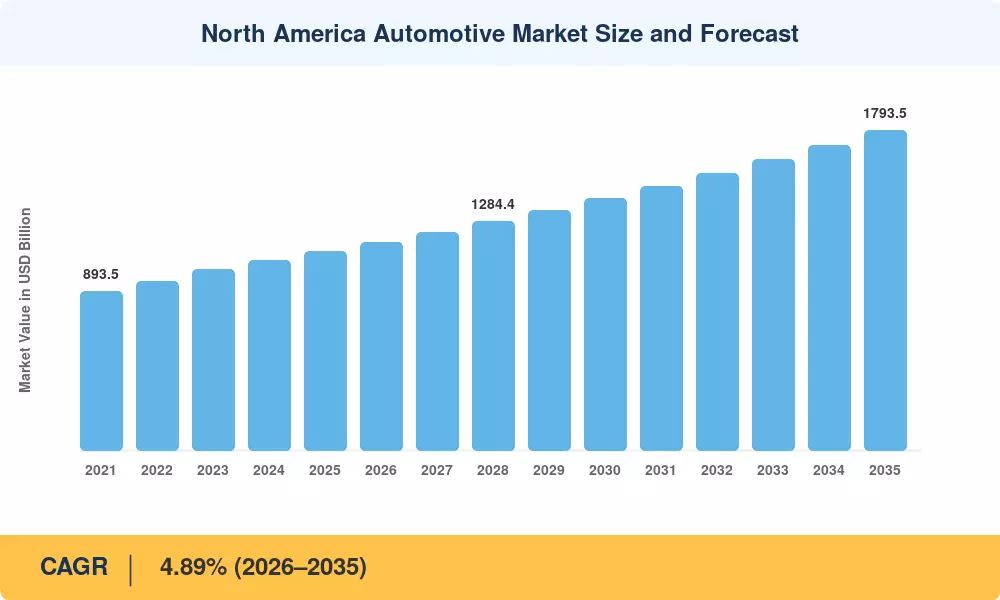
NEW YORK, NY, UNITED STATES, August 31, 2026 /EINPresswire.com/ — According to Market Research Future, the North America Automotive Market is projected to reach USD 1,793.5 Billion, at a CAGR of 4.89% during 2026 to 2035, driven by Expansion of electric vehicle infrastructure and adoption. This steady growth reflects the region’s ongoing structural transformation, where the convergence of aggressive zero-emission mandates, multi-billion-dollar battery localization investments, and rising software-defined vehicle architectures is redefining the competitive landscape. The North America Automotive Market continues to expand as automakers balance near-term profitability from SUVs and light trucks with long-term electrification commitments, while the Automotive AfterMarket adapts to an aging vehicle fleet and increasing vehicle complexity.
Market Overview
The North American automotive market is undergoing a fundamental transition, shaped by regulatory mandates, technological innovation, and shifting consumer preferences. With approximately 78% of vehicles in North America manufactured domestically, the region maintains a robust production ecosystem valued at over USD 1 trillion . Passenger cars anchor approximately 68.6% of current revenue, though medium and heavy commercial vehicles are expanding at a faster pace of 8.2% CAGR as fleet operators prioritize electrification and total-cost-of-ownership gains . The market is characterized by high transaction prices averaging over USD 50,000, with SUVs and trucks commanding an 80% share of sales, reflecting North American consumers’ enduring preference for larger vehicles .
The key growth drivers propelling this market expansion include aggressive regulatory mandates across federal and state levels. California’s Advanced Clean Cars II regulation requires 35% zero-emission sales by 2026 and 100% by 2035, with eleven additional states and Washington, D.C. adopting identical timelines . Canada’s federal ZEV rule mirrors the 2035 deadline with interim 20% and 60% milestones for 2026 and 2030, respectively . Proposed U.S. EPA limits push 30% zero-emission medium- and heavy-truck sales by 2030, rising to 100% by 2040, creating long-term demand certainty for electric vehicles and supporting infrastructure .
The expansion of electric vehicle infrastructure is a critical growth driver. The National Electric Vehicle Infrastructure (NEVI) program is deploying substantial funding to install public chargers across the country, directly reducing range anxiety and accelerating EV adoption . Battery “Auto-Alley” localization has seen cumulative North American supply-chain commitments top USD 250 billion, with cell plants positioned a median 284 miles from final assembly sites, mitigating logistics expense and tariff risk . Canada has risen first in the lithium-ion supply-chain ranking, buoyed by Honda’s CAD 15 billion integrated complex slated for 2028, while Mexican projects such as BMW’s USD 800 million San Luis Potosí expansion secure cost-competitive capacity while preserving USMCA trade eligibility .
Market Segmentation
The North American automotive market is segmented based on vehicle type, propulsion type, sales channel, and level of automation to provide comprehensive insights into the industry landscape.
By Vehicle Type: The market is categorized into Passenger Cars, Light Commercial Vehicles, and Medium & Heavy Commercial Vehicles. Passenger cars anchor approximately 68.6% of current revenue but face affordability pressures and rising compliance outlays . Medium and heavy commercial vehicles, though smaller in absolute volume, expand at 8.2% CAGR through 2031, outpacing passenger cars, as regulatory pushes from California’s Advanced Clean Trucks rule and U.S. EPA proposals target 100% zero-emission truck sales by 2040 . Fleet buyers embrace electrification where charging can be centralized and duty cycles predictable, with total-cost-of-ownership parity for zero-emission trucks by 2035 further tilting investment toward commercial applications .
By Propulsion Type: The market covers Internal Combustion Engine, Battery Electric Vehicle, and Hybrid/Plug-In Hybrid segments. ICE powertrains command 82.1% share in 2025, however BEVs capture incremental gains at 9.6% CAGR, supported by up to USD 7,500 clean-vehicle tax credits under the Inflation Reduction Act . Hybrid models act as a bridge technology, with Ford reporting double-digit hybrid sales gains in 2024 . However, BEV evolution expectations have been reevaluated, with a 60% reduction in 2030 forecast, signaling a more measured electrification trajectory than previously anticipated . Plug-in hybrids provide range assurance for long-distance drivers while meeting partial electrification quotas, and fuel-cell offerings remain niche, limited by hydrogen infrastructure gaps .
By Sales Channel: The market serves OEM-Franchised Dealers, Direct-to-Consumer, and Online/Third-Party Platforms. Direct-to-consumer sales models continue to pressure entrenched dealer networks, with automakers exploring alternative distribution strategies to reduce costs and enhance customer experience . Online platforms are gaining traction, particularly for vehicle discovery and initial purchase consideration, though traditional dealerships remain dominant for final transactions and service.
By Level of Automation: The market covers Level 0–1, Level 2, Level 3, and Level 4–5 segments. Level 2 automation is becoming increasingly prevalent across passenger and commercial vehicle segments, while higher levels of automation remain limited in commercial deployment. The widespread integration of ADAS into vehicles will require aftermarket suppliers and workshops to adapt their service capabilities and business models to meet the demands of these advanced systems . By 2035, over 1.1 billion VIO globally are expected to feature various levels of ADAS, with adoption projected to reach 71% of VIO .
By Region: The market covers North America, with detailed analysis for the United States, Canada, and Mexico.
🛒 You can buy this market report at:
https://www.marketresearchfuture.com/checkout?currency=one_user-USD&report_id=21670
Automotive Aftermarket Outlook
The North American automotive aftermarket remains structurally supported by growth in the vehicle parc and increasing vehicle age . The North American aftermarket accounted for 27.4% of the global market, reaching USD 122.21 billion in 2025, supported by an aging vehicle fleet, high vehicle ownership, and strong demand for premium replacement parts . The U.S. market was valued at USD 100.21 billion in 2025, making it the largest contributor in North America, while Canada’s market reached USD 22.00 billion .
Vehicle age continues to be a key demand driver. The global number of vehicles in operation is forecast to reach 1.9 billion light vehicles by 2034, compared with 1.6 billion in 2025 . In North America, rising new vehicle prices, uncertainty around battery-electric vehicles, and affordable maintenance are key factors driving up the average vehicle age . The rising adoption of ADAS is driving higher penetration rates within the VIO and creating maintenance and repair opportunities in the aftermarket, including calibration and replacement services .
Technology remains a critical disruptor in the aftermarket. The increasing penetration of electrified powertrains and software-driven vehicle architectures is redefining service requirements, with the growing presence of xEVs in the serviceable parc highlighting a widening capability gap that is expected to drive the next wave of transformation and value creation across the industry .
Competitive Landscape and Key Players
The North American automotive market is highly competitive, featuring a mix of established legacy automakers, emerging EV specialists, and technology providers. The competitive landscape is characterized by vertical integration, strategic partnerships, and manufacturing localization.
Key players operating in this market include General Motors, Ford Motor Company, Stellantis, Tesla, Toyota Motor North America, Honda Motor Co., Nissan North America, and Hyundai Motor Group. Automakers are localizing battery and vehicle production at unprecedented speed, balancing short-term profitability from light-truck and SUV sales with long-term electrification commitments .
Strategic developments are reshaping the competitive landscape. Cumulatively, North American battery supply-chain commitments surpassed USD 250 billion by end-2023, with cell fabrication absorbing approximately half of the outlays . Plant retooling for multi-powertrain flexibility enables manufacturers to modulate output amid shifting demand . In response to tariff policies, roughly 55% of U.S. vehicle sales are now produced in-region as automakers shifted assembly and supplier capacity closer to home .
Innovation and technology initiatives are accelerating across the industry. Companies are investing heavily in software-defined vehicle architectures, which enable continuous feature updates and new revenue models. The shift toward centralized computing platforms and zonal architectures is reducing ECU complexity while enabling scalable vehicle capabilities. Deal flow held strong at 104 transactions in Q1 2026, with strategic acquirers driving roughly 90% of activity and anchoring consolidation across the value chain .
Market Challenges and Opportunities
The North American automotive market faces several key challenges that could impact growth trajectories. Record transaction prices have pushed average monthly payments to historic highs, sidelining a swath of mainstream buyers . The pinch is most acute for battery-electric models whose upfront premiums outweigh lifetime savings for many households, with price sensitivity capping near-term volume upside . Intensifying tariff policies and critical-mineral bottlenecks remain near-term headwinds, adding cost pressure and supply chain complexity . Peak-hour “charging-queue” anxiety and charging infrastructure gaps continue to constrain EV adoption .
Emerging opportunities are abundant in the evolving automotive landscape. The NEVI-funded EV-charging build-out is expanding infrastructure accessibility across the region . The software-defined-vehicle revenue model, including subscriptions and feature-on-demand offerings, presents significant growth potential for automakers and technology providers . The growing demand for ADAS calibration and specialized diagnostics in the aftermarket creates new service opportunities . The trend toward local battery manufacturing and resilient supply chains will continue to support regional economic development and reduce tariff exposure.
To explore more market insights, visit us at:
https://www.marketresearchfuture.com/reports/north-america-automotive-market-21670
Final Market Summary
The North America automotive market is positioned for steady growth, driven by regulatory mandates, technological innovation, and infrastructure expansion. The market’s trajectory to USD 1,793.5 Billion by 2035 reflects the region’s ongoing transformation from traditional internal combustion propulsion to a diversified mobility ecosystem encompassing electric vehicles, software-defined platforms, and advanced driver assistance systems.
The long-term industry potential remains robust, with advancements in battery technology, electric vehicle infrastructure, and autonomous driving continuing to expand the addressable market. The convergence of automotive with broader mobility ecosystems, including connected vehicle platforms, smart grid integration, and software services, is creating comprehensive solutions that serve diverse customer needs across passenger and commercial segments.
Key factors expected to influence future development include the pace of regulatory implementation across states and provinces, advancements in battery energy density and cost reduction, and the evolution of consumer adoption patterns. The development of resilient domestic supply chains for batteries and critical minerals will address tariff risks and supply chain vulnerabilities. As electric vehicles become more affordable, charging infrastructure expands, and software-defined features enhance vehicle value, the North American automotive market will continue to evolve, ensuring sustained innovation and growth throughout the forecast period and beyond.
More Related Reports from MRFR Library:
US Automotive PCB Market : https://www.marketresearchfuture.com/reports/us-automotive-pcb-market-18230
Automotive Brake By Wire BBW Systems Market : https://www.marketresearchfuture.com/reports/automotive-brake-by-wire-systems-market-21308
India Auto Parts Market : https://www.marketresearchfuture.com/reports/india-auto-parts-market-21432
India Automotive Wiring Harness Market : https://www.marketresearchfuture.com/reports/india-automotive-wiring-harness-market-21668
Racing Simulator Market : https://www.marketresearchfuture.com/reports/racing-simulator-market-21942
Automotive Ethernet Market : https://www.marketresearchfuture.com/reports/automotive-ethernet-market-21944
Class 8 Truck Market : https://www.marketresearchfuture.com/reports/class-8-truck-market-22479
Light Vehicle Market : https://www.marketresearchfuture.com/reports/light-vehicle-market-23154
Electric Outboard Motors Market : https://www.marketresearchfuture.com/reports/electric-outboard-motors-market-23537
Automotive Dealership Market : https://www.marketresearchfuture.com/reports/automotive-dealership-market-24079
Market Research Future
Market Research Future
+1 855-661-4441
email us here
Legal Disclaimer:
EIN Presswire provides this news content “as is” without warranty of any kind. We do not accept any responsibility or liability
for the accuracy, content, images, videos, licenses, completeness, legality, or reliability of the information contained in this
article. If you have any complaints or copyright issues related to this article, kindly contact the author above.

Media gallery