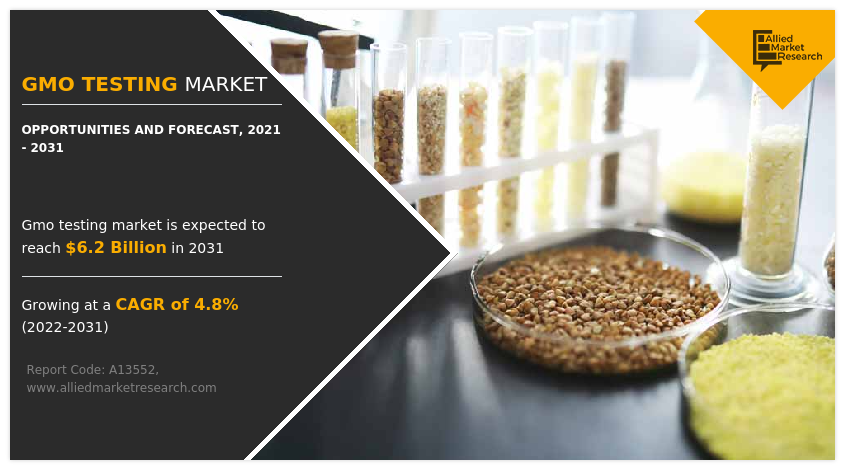
GMO Testing Market (2021 – 2031) Size, Share, Competitive Landscape and Trend Analysis Report, by Technology, by Crop Type, by Trait and by Region.
WILMINGTON, DE, UNITED STATES, June 22, 2026 /EINPresswire.com/ — GMO testing market is predicted to garner a revenue of $6.2 billion by 2031. The market was valued at $3.9 billion in 2021 and is estimated to experience a growth at a CAGR of 4.8% during the 2022-2031 period.
The global GMO testing market is expected to be driven by the rising adoption of genetically modified (GM) crops across the globe.
The growth of GMO testing can be attributed to several factors, including increasing consumer demand for transparency and information about the food they eat, the need for reliable and accurate testing methods to ensure compliance with regulatory requirements, and advances in technology that have made testing faster and more precise.
Download Sample Report: https://www.alliedmarketresearch.com/request-sample/A13552
Widespread adoption of genetically modified (GM) crops is predicted to be the primary growth driver of the global GMO testing market. However, inadequate knowledge regarding food safety standards might create hurdles in the surge of the market. Nonetheless, the intensifying adoption of instant test kits is estimated to push the market ahead.
The GMO testing market refers to the market for testing genetically modified organisms (GMOs) in food, feed, and other products. GMO testing is important to ensure the safety and quality of these products and to meet regulatory requirements in many countries. In recent years, the demand for GMO testing has been increasing due to several factors. One of the main drivers of demand is the growing consumer awareness and concern about the use of GMOs in food and other products. Many consumers are seeking non-GMO products, and retailers and manufacturers are responding by labeling their products as non-GMO and conducting GMO testing to verify the claims. Another factor driving demand for GMO testing is the increasing regulatory requirements in many countries. Several countries have established regulations requiring the labeling or testing of GMOs, and these regulations are expected to become more stringent in the future.
The increasing demand for organic and non-GMO products is also contributing to the GMO Testing Market Growth. Organic and non-GMO certifications often require GMO testing as part of the certification process. Overall, the GMO testing market is expected to continue to grow in the coming years, driven by consumer demand, regulatory requirements, and the growth of the organic and non-GMO market segments. However, the GMO testing market faces certain challenges including a lack of standardized testing methods, lack of awareness, regulatory challenges, limited testing capacity, and resistance from the biotech industry. There is currently no universally accepted standard for GMO testing, which can lead to variability in results and create confusion among consumers and manufacturers.
LIMITED-TIME OFFER – Buy Now & Get Exclusive Discount on this Report @ https://www.alliedmarketresearch.com/checkout-final/a8613c008044a153b3f83bdbea30acfb
Despite growing consumer awareness of GMOs, many people still do not understand the science behind GMO testing or the reasons why it is important. This lack of awareness can limit the demand for GMO testing. Also, while regulatory requirements for GMO testing can drive demand, they can also create challenges for companies and governments. For example, different countries may have different regulations or testing requirements, which can create barriers to trade. Biotechnologically altered food products are being sold in the market for many years. GMOs contained in human food or feed samples are identified and quantified using polymerase chain reaction (PCR) tests, which further provide the independent confirmation clients require to engage in risk-free trading.
Particularly in Europe, the public discussion about genetically modified crops and new genomic breeding technology is still debated. Opponents ignore current and future benefits in favor of concentrating exclusively on speculative hazards. The adoption of genetically modified crops results in increased agricultural yields, higher farm income, and, in some circumstances, lower chemical pesticide use. Further, specific genetically modified crop sprays encourage less tillage farming, which lowers GHG emissions and supports carbon absorption in the soil. Testing, monitoring, and labeling GMOs have significant economic value for businesses and consumers and agricultural groups.
To detect, safeguard, modify, or keep a seed’s genetic identity, seed makers must do GMO testing during their study. To ensure that seed lots are generated with the intended presence and absence of particular genetically modified traits at the specified purity, seed manufacturers also use GMO testing. A representative sample of the seed lot is tested for the presence of GMOs, and each seed is individually examined as part of the statistical process known as seed testing. GMO testing gives farmers detailed information about the integrity and composition of crops, which is essential for tracking and buying seeds. GMO testing is essential for grain handlers and mills to separate grain meant for different end users. GMO testing thereby enables grain growers, suppliers, and consumers to make knowledgeable decisions regarding their crops and how they use them. Thus, this is likely to bring GMO Testing Market Opportunities.
For Purchase Enquiry: https://www.alliedmarketresearch.com/purchase-enquiry/A13552
By region, the North America GMO testing industry accounted for the largest market share in 2021, with around two-fifths of the total share. The extensive use of GM crops such as soybeans, corn, and cotton in the food industry is estimated to propel the market ahead. On the other hand, the market in the Asia-Pacific region is anticipated to demonstrate the fastest CAGR of 7.1% during the analysis timeframe. The high consumer demand for GM crops and various export requirements are expected to drive the market in this region.
Leading Companies in the Industry:
ALS Limited
Eurofins Scientific
OMIC USA Inc
Premier Foods plc
Institut Merieux
SGS SA
EnviroLogix Inc.
Bio-Rad Laboratories, Inc.
Intertek Group plc
Koninklijke DSM N.V.
TUV SUD AG
LGC Limited
Microbac Laboratories, Inc.
Thermo Fisher Scientific Inc.
R-Biopharm AG
Trending Reports:
Precision Fermentation Market: https://www.alliedmarketresearch.com/precision-fermentation-market-A53640
IOT in Agriculture Market: https://www.alliedmarketresearch.com/internet-of-things-iot-in-agriculture-market
Anhydrous Milk Fat Market: https://www.alliedmarketresearch.com/anhydrous-milk-fat-market-A53446
David Correa
Allied Market Research
+ + + + + + + + + + + + + +1 800-792-5285
email us here
Visit us on social media:
LinkedIn
Facebook
YouTube
X
What Sets Us Apart ? – Allied Market Research
Legal Disclaimer:
EIN Presswire provides this news content “as is” without warranty of any kind. We do not accept any responsibility or liability
for the accuracy, content, images, videos, licenses, completeness, legality, or reliability of the information contained in this
article. If you have any complaints or copyright issues related to this article, kindly contact the author above.

Media gallery