A scanning-free approach for higher resolution and faster imaging
CHINA, June 26, 2026 /EINPresswire.com/ — Non-line-of-sight (NLOS) imaging enables recovery of hidden scenes but is constrained by a speed-resolution trade-off in conventional scanning systems. We propose a scanning-free approach based on laser reflective tomography, using a diffuse relay surface as a natural beam expander and requiring only single-point detection. This method achieves twofold higher resolution and 91-fold faster imaging, and enables 3.3 km long-range reconstruction with 3 cm resolution in just 3 minutes.
Conventional optical imaging systems are limited to objects within the direct line of sight. In contrast, non-line-of-sight (NLOS) imaging overcomes this constraint by detecting photons that undergo multiple scattering in the environment, enabling computational reconstruction of occluded scenes. This capability holds significant promise for applications such as autonomous driving, disaster rescue, medical diagnostics, and industrial inspection.
However, most existing NLOS imaging approaches rely on scanning mechanisms to acquire spatial information, leading to an inherent speed-resolution trade-off. Achieving high spatial resolution requires dense, large-area scanning of the relay surface, which significantly increases acquisition time. Conversely, reducing the number of sampling points to improve speed results in undersampling and loss of image details. This challenge becomes even more pronounced in long-range scenarios, where the energy of multiply scattered photons attenuates rapidly.
Laser reflective tomography offers the potential to surpass diffraction limits and achieve high-resolution reconstruction. Introducing this technique into NLOS imaging provides a promising new pathway to address the aforementioned trade-off.
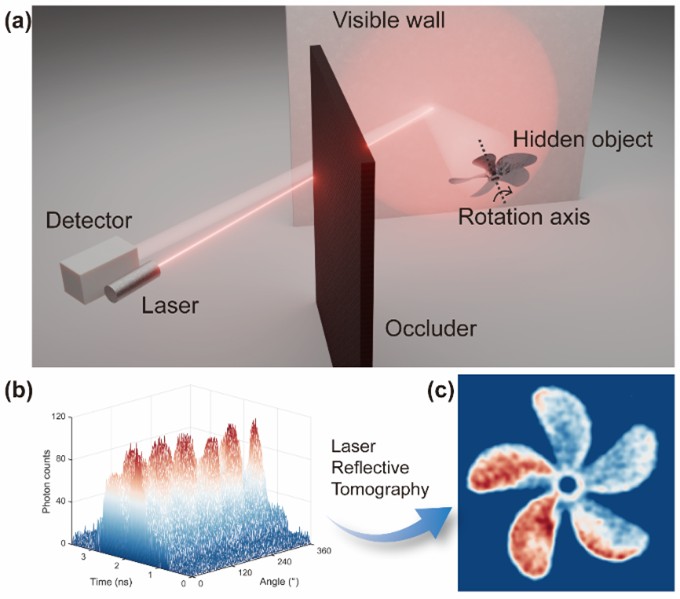
To address these challenges, the research team at the Institute of Optics and Electronics, Chinese Academy of Sciences, has innovatively introduced laser reflective tomography (LRT) into the field of non-line-of-sight imaging. Their study was made available online on May 08, 2026, in the journal Opto-Electronic Science. In this approach, the diffusely reflecting relay wall is cleverly exploited as a natural laser beam expander, allowing the system to acquire scattered-photon signals using only single-point detection. By combining these signals with multi-angle projection data generated by target rotation, the hidden scene can then be reconstructed with high fidelity through tomographic algorithms. This strategy fundamentally removes the reliance of conventional scanning-based NLOS imaging on large-area relay-surface scanning, greatly reducing data-acquisition complexity while overcoming the long-standing trade-off between spatial resolution and imaging speed. As a result, it establishes a new paradigm for long-range, high-resolution, and rapid NLOS imaging. Building on this concept, the team not only achieved simultaneous improvements in resolution and imaging speed under laboratory conditions, but also successfully extended the method to kilometer-scale stand-off scenarios.
***
Reference
Title of original paper: Breaking the speed-resolution trade-off in 3.3-km non-line-of-sight imaging using scanning-free laser reflective tomography
Journal: Opto-Electronic Science
DOI: 10.29026/oes.2026.260007
Funding information
This work was supported by the National Key Research and Development Program of China (2023YFB2805800); National Natural Science Foundation of China (U24A6010, U25A20518); Sichuan Science and Technology Program (2021ZYCD001).
Siyi Ma
Institute of Optics and Electronics
oej_publishing@ioe.ac.cn
Legal Disclaimer:
EIN Presswire provides this news content “as is” without warranty of any kind. We do not accept any responsibility or liability
for the accuracy, content, images, videos, licenses, completeness, legality, or reliability of the information contained in this
article. If you have any complaints or copyright issues related to this article, kindly contact the author above.

Media gallery