Vadzo Imaging’s Falcon-544CRS is a 5MP color USB camera built on the Onsemi AR0544 HyperLux sensor, delivering rolling shutter imaging with embedded HDR and low power consumption in a compact USB 3.2 UVC-compliant module engineered for continuous deployment in environmental monitoring, waste classification, fill-level detection, contamination sensing, and smart waste management system applications where uninterrupted field operation and visual accuracy under variable outdoor lighting are hard system requirements.
SAN DIEGO, CA / ACCESS Newswire / August 6, 2026 / Vadzo Imaging, a provider of embedded vision solutions, today announces the deployment positioning of the Falcon-544CRS, a low-power USB camera built on the Onsemi AR0544 HyperLux sensor for OEM developers and system integrators building field-deployed vision systems in environmental monitoring, waste management, and industrial sensing infrastructure. The Falcon-544CRS brings 5MP rolling shutter color imaging with embedded HDR and a low-power sensor architecture to USB 3.2 UVC-compliant deployment on a compact 38mm x 38mm board, making it directly applicable to edge-deployed smart waste monitoring nodes, fill level monitoring systems, contamination detection platforms, and automated waste inspection pipelines where host-side processing capacity is constrained, and continuous outdoor operation is the operating baseline.
The Imaging Challenge in Environmental Monitoring and Waste Classification Systems
Deploying a waste management camera in field conditions exposes a consistent set of sensor-level limitations that standard industrial camera products are not designed to handle. Environmental monitoring and waste classification deployments run continuously. The camera must function at dawn, midday, dusk, and under artificial illumination inside collection facilities, generating usable frames across a dynamic range that a single fixed exposure cannot span. A bin monitoring camera installed at an outdoor smart bin faces direct sunlight on one side of the container and shadow from the bin lid on the other. Fill-level detection algorithms trained on 5MP spatial data lose classification confidence when image quality degrades under non-uniform lighting. Waste segregation systems that classify material by visual texture and color fail when the dynamic range is insufficient to distinguish between materials at the sensor level.
Power consumption is the second constraint. Environmental monitoring and waste management infrastructure operate on limited power budgets, particularly at remote locations. A camera node drawing unnecessary power during periods of inactivity shortens battery life or increases solar panel sizing requirements.
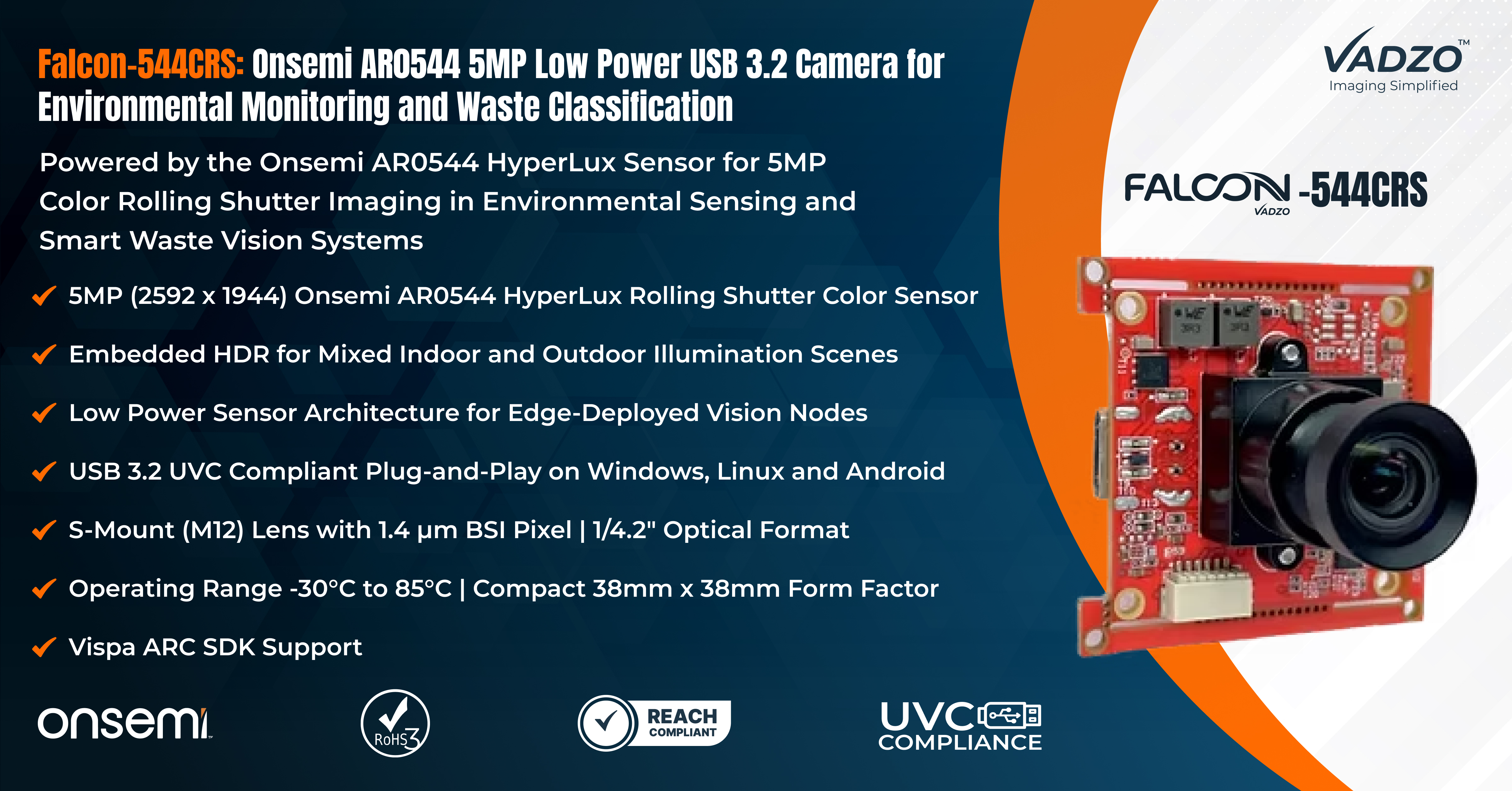
Sensor and Camera Overview
The Falcon-544CRS is built on the Onsemi AR0544 HyperLux sensor, a 1/4.2″ back-illuminated CMOS rolling shutter image sensor with 1.4 µm x 1.4 µm pixel pitch and a maximum resolution of 5MP (2592 x 1944). The HyperLux architecture is Onsemi’s low-power imaging platform, designed for embedded applications where thermal budget and supply current per module directly affect system-level power planning. The AR0544 delivers embedded HDR processing on board, providing the low-power embedded camera platform with consistent frame quality under mixed indoor and outdoor illumination without requiring multi-frame HDR merging at the host. The back-illuminated pixel structure maximizes photon collection per pixel at the 1.4 µm pitch, improving the signal-to-noise ratio in the low-luminance conditions common at dawn and dusk in outdoor environmental sensing deployments.
Key specs: 5MP (2592 x 1944) | Onsemi AR0544 HyperLux | 1/4.2″ | 1.4 µm Pixel Size | Rolling Shutter | Color | USB 3.2 | S-Mount (M12) | -30°C to 85°C Operating Temperature | 38mm x 38mm | Windows, Linux, and Android | UVC Compliant | RoHS 3 and REACH Compliant
Key Capabilities of the Onsemi AR0544 Low Power USB Camera
Onsemi AR0544 HyperLux Sensor with Embedded HDR and Low Power Architecture
The AR0544 is part of Onsemi’s HyperLux sensor family, a platform engineered specifically for low-power embedded vision where the imaging module must not become the dominant current draw in a battery-backed or solar-powered edge node. The 1.4 µm BSI pixel architecture on the AR0544 places the photodiode layer on the light-receiving side of the chip, maximizing photon collection at the pixel level and improving sensitivity at lower illuminance levels.
Embedded HDR processing on the AR0544 handles high-contrast scenes without requiring the host processor to merge multiple exposures. In waste classification and fill-level detection deployments, this matters directly: a waste bin positioned under direct overhead lighting creates a scene where the bin interior sits in deep shadow while the surrounding environment is fully illuminated. Without embedded HDR, the imaging system must choose one exposure setting and lose detail in either the shadow or the highlight region. With embedded HDR active, the AR0544 USB color camera captures usable detail across the full contrast range in a single frame output, giving the downstream classification algorithm consistent input data regardless of outdoor lighting conditions.
5MP Rolling Shutter for High-Resolution Waste Detection and Environmental Imaging
At 5MP (2592 x 1944), the Falcon-544CRS delivers the spatial resolution needed for waste stream analysis, material classification, and fill-level measurement at the sensor level without requiring post-capture upscaling. In a waste detection camera deployment, spatial resolution directly determines the smallest waste item or contamination particle that the classification algorithm can detect reliably. At 2MP or lower, fine-grained materials, including glass fragments, small plastic particles, and paper fibers near the lower size threshold of the classification model, fall below the effective pixel density available at the scene scale. The 5MP rolling shutter architecture of the AR0544 provides the pixel budget to resolve these smaller material categories within the field of view of a compact bin-mounted or conveyor-mounted camera module.
USB 3.2 UVC Compliance for Driverless Integration on Embedded Edge Platforms
The Falcon-544CRS connects via USB 3.2 and is fully UVC compliant, operating as a standard video input device on Windows, Linux, and Android without any custom driver installation. For OEM engineers building smart waste monitoring and environmental sensing platforms on ARM-based edge compute boards, this matters directly. Driver development adds weeks to integration timelines, introduces OS-version compatibility dependencies, and creates ongoing maintenance obligations when the edge compute platform firmware is updated in the field. UVC compliance eliminates this entirely. The camera registers on connection and streams immediately, making it deployable across the range of embedded Linux distributions and Android-based edge AI systems used in smart waste management system infrastructure without code-level driver work.
Compact Form Factor for Field Enclosure and Smart Bin Integration
The Falcon-544CRS measures 38mm x 38mm and operates across -30°C to 85°C. This combination of compact board footprint and wide thermal operating range directly addresses the installation requirements of field-deployed environmental monitoring and waste management infrastructure. The 38mm x 38mm footprint integrates directly into standard compact enclosure profiles. The -30°C to 85°C operating range covers outdoor deployment in temperate and sub-arctic climates across seasonal temperature cycling without enclosure-level active thermal management.
RoHS 3 and REACH conformance qualify the Falcon-544CRS as a production-ready component for waste management and environmental sensing products shipped into regulated markets globally.
|
Specification
|
Details
|
|
Sensor
|
Onsemi AR0544 HyperLux
|
|
Sensor Format
|
1/4.2″
|
|
Resolution
|
5MP (2592 x 1944)
|
|
Pixel Size
|
1.4 µm x 1.4 µm
|
|
Shutter Type
|
Rolling Shutter
|
|
Output
|
Color
|
|
Interface
|
USB 3.2 Gen1 Type C Interface Backward Compatible to USB 2.0
|
|
Optics
|
S-Mount (M12 Standard)
|
|
Operating Temperature
|
-30°C to 85°C
|
|
Board Dimensions
|
38mm x 38mm
|
|
Platform Support
|
Windows, Linux, Android
|
|
Compliance
|
UVC, RoHS 3, REACH
|
|
SDK
|
VISPA ARC SDK
|
“Environmental monitoring and waste management deployments have specific imaging requirements that general-purpose camera products do not address, including low power consumption for field-deployed nodes, embedded HDR for outdoor lighting variability, and plug-and-play USB integration for embedded Linux platforms that cannot absorb custom driver work. The AR0544 HyperLux sensor addresses all three at the sensor architecture level. The Falcon-544CRS puts those capabilities on a USB 3.2 UVC platform in a form factor that fits inside real field enclosures. It is positioned specifically for the waste classification, fill-level detection, contamination sensing, and environmental monitoring use cases where those three constraints show up simultaneously.” – Alwin Vincent, Product Manager, Vadzo Imaging
Application-Specific Deployments
Environmental Monitoring and Remote Sensing: Environmental monitoring deployments span a broad range of field sensing scenarios, including air quality station visual monitoring, water body surface change detection, vegetation boundary mapping, erosion tracking, and perimeter surveillance at environmental compliance sites. The common engineering requirement across these applications is a camera that delivers consistent image quality under outdoor lighting conditions across a full operational day without requiring manual recalibration or host-side exposure correction. The Falcon-544CRS addresses this directly through the AR0544 HyperLux embedded HDR capability, which handles the dynamic range variation from low-angle morning light to direct midday sun within a single exposure framework.
Remote environmental monitoring camera nodes are typically solar-powered or battery-backed. Total power draw per module determines how long the node operates between charge cycles and how much energy harvesting hardware the system integrator must size. The AR0544 HyperLux low-power architecture reduces the imaging module’s contribution to the node power budget, extending runtime and allowing energy harvesting system sizing to remain practical in remote locations without grid access.
Waste Classification and Intelligent Waste Sorting: Automated waste inspection and material sorting systems use computer vision to classify waste stream content in real time, separating recyclables from residual waste, identifying contamination in otherwise clean material streams, and routing individual items to the correct downstream process path. The accuracy of these classifications depends directly on the input image quality at the camera level. Classification models trained on 5MP labeled datasets lose inference confidence when deployed with lower-resolution sensors that reduce pixel density across the classification region of interest. The Falcon-544CRS, as a waste classification camera, provides the 5MP spatial resolution that waste sorting algorithms require to distinguish fine-grained material categories at the feature level.
Indoor waste sorting facilities use conveyor systems illuminated by industrial lighting that creates significant contrast variation across the belt. Near the light fixture, the belt surface reaches saturation for standard sensors. In the shadow zones between fixtures, the image drops below the threshold for reliable color-based material identification. The AR0544’s embedded HDR processing handles this within the sensor pipeline, delivering tonally balanced frames to the edge AI inference node without requiring the application to implement exposure bracketing or multi-frame merging.
Fill-Level Detection and Smart Bin Monitoring: Fill-level detection in waste management infrastructure uses computer vision to assess bin occupancy state and trigger collection routing when fill thresholds are met. The core imaging requirement for this application is the ability to capture clear visual depth cues within the bin interior, which typically presents as a high-contrast scene with a bright external environment and a darker interior. Ultrasonic and weight-based fill sensors provide occupancy data but cannot discriminate between normal fill and abnormal load configurations, such as a single large item blocking the sensor aperture or compacted waste artificially increasing weight without approaching visual capacity. Visual fill-level monitoring with a bin monitoring camera provides the depth and texture cues that confirm actual volumetric occupancy, reducing false positives in collection scheduling algorithms.
The embedded HDR capability of the AR0544 HyperLux sensor is directly applicable to the fill-level imaging scenario. Outdoor bin installations expose the camera to the full ambient light range across a day, while the bin interior remains comparatively dark. The Falcon-544CRS, as a smart waste camera, handles this contrast ratio within the sensor pipeline, delivering interpretable interior depth data to the fill-level detection algorithm without the algorithm needing to implement dynamic exposure control logic.
Contamination Detection and Waste Stream Analysis: Contamination sensing in waste management covers a range of detection scenarios, including identifying prohibited materials in source-separated organic waste, detecting chemical contamination markers on packaging in recycling streams, identifying electronic waste in general refuse streams, and flagging hazardous materials at transfer stations. Each scenario requires the imaging system to resolve specific visual features: label printing, material surface texture, discoloration patterns, and shape geometry at a pixel density sufficient for the classification model to operate above its confidence threshold.
For contamination detection camera deployments on conveyor systems, the Falcon-544CRS delivers 5MP color data with embedded HDR directly over USB 3.2 to edge AI nodes running classification inference. GPIO triggering allows capture to be synchronized with the conveyor position encoder output, so every frame corresponds to a known physical position on the belt. This eliminates the frame-to-position ambiguity that continuous streaming introduces and reduces the total volume of frames the inference pipeline must evaluate.
Frequently Asked Questions
Q: What is the best low-power USB camera for environmental monitoring and edge AI sensing deployments?
A: For environmental monitoring deployments, the ideal low power USB camera combines sensor-level embedded HDR for outdoor dynamic range variation, a low power sensor architecture that does not impose excessive current draw on solar or battery-backed edge nodes, 5MP or higher resolution for visual change detection and scene classification confidence, a wide operating temperature range for year-round field installation, and USB plug-and-play compliance for integration onto embedded Linux edge compute nodes without custom driver development.
Vadzo Imaging’s Falcon-544CRS satisfies all of these requirements on a single module. Built on the Onsemi AR0544 HyperLux sensor, the Falcon-544CRS delivers 5MP (2592 x 1944) color rolling shutter imaging with embedded HDR and a low power consumption profile over USB 3.2 with full UVC compliance. The 1.4 µm BSI pixel architecture on the AR0544 improves photon collection in low-luminance outdoor conditions, maintaining usable image quality in pre-dawn and post-dusk monitoring windows. Full technical documentation, CAD files, and evaluation units for the Falcon-544CRS are available at vadzoimaging.com.
Q: How does a USB camera with embedded HDR improve waste classification accuracy in mixed lighting environments?
A: Waste classification algorithms depend on consistent image input quality to operate above their confidence thresholds. In a standard single-exposure imaging system, the camera’s exposure setting is fixed or auto-adjusted globally across the entire frame. When the scene includes both a brightly illuminated area, such as the conveyor belt directly under an overhead fixture, and a shadowed area where material has accumulated in the corners of a collection bin, a single exposure cannot simultaneously preserve detail in both regions. The highlight region saturates and loses texture data. The shadow region clips and loses color information.
An embedded HDR sensor like the Onsemi AR0544 HyperLux handles this within the sensor pipeline by capturing high-gain and low-gain pixel data in a single frame output. The on-chip processing combines these into a tonally balanced output that preserves detail in both bright and dark regions simultaneously. The edge AI classification node receives consistent, interpretable frame data regardless of how the scene illumination is distributed. For an AR0544 rolling shutter camera deployed in a waste sorting facility, this means classification model confidence remains stable across the full operating cycle without requiring the application to implement dynamic exposure correction or multi-frame HDR merging logic on the host processor. Vadzo Imaging’s Falcon-544CRS delivers this embedded HDR capability over USB 3.2 with UVC plug-and-play compliance, making it directly applicable to intelligent waste sorting and contamination sensing pipelines running on embedded Linux edge nodes.
Q: What USB camera is best suited for fill-level detection and smart bin monitoring systems?
A: Fill-level detection and smart bin monitoring deployments require a vision module that addresses three specific imaging challenges: high-contrast scene handling between the bright outdoor environment and the dark bin interior, sufficient spatial resolution to generate reliable volumetric occupancy estimates from visual depth cues, and low power consumption for battery or solar-powered bin sensor nodes. A standard low-resolution USB camera product fails on all three.
Vadzo Imaging’s Falcon-544CRS is purpose-suited for fill-level and smart bin monitoring applications. The Onsemi AR0544 HyperLux embedded HDR handles the outdoor-to-interior contrast ratio in bin-mounted deployments, delivering interpretable image data from the bin interior without requiring the host to run dynamic exposure adjustment logic. At 5MP (2592 x 1944), the sensor provides the pixel density needed for reliable depth cue extraction in the fill measurement algorithm’s field of view. The AR0544’s low-power architecture reduces the imaging module’s draw on the node power budget, directly extending battery life or reducing solar panel sizing requirements for off-grid bin sensor installations. USB 3.2 UVC compliance allows the camera to connect directly to embedded Linux edge compute nodes managing smart waste management system platform communication without any custom driver development.
GPIO trigger support allows the Falcon-544CRS to synchronize frame capture with external sensors in the bin monitoring node, such as proximity detectors or door open sensors that indicate when waste is being added. This reduces unnecessary continuous streaming and lowers edge compute utilization in deployments where the bin is idle for extended periods.
Q: How does a 5MP rolling shutter USB camera compare to lower-resolution options for waste stream analysis and contamination sensing?
A: The resolution of a waste detection camera directly determines the smallest material feature or contaminant particle that the classification algorithm can identify reliably at a given field of view and mounting distance. Classification models trained on 5MP datasets perform at their rated accuracy only when the inference input matches the resolution the model was trained on. Deploying a 2MP camera in a system where the model expects 5MP input either requires downscaling the model’s classification field or accepting reduced detection confidence for smaller material categories.
In practical waste stream analysis terms, a 5MP sensor at a 600mm mounting height over a 400mm wide conveyor belt resolves approximately 154 pixels per centimeter of belt width. A 2MP sensor at the same geometry resolves roughly 70 pixels per centimeter. Glass fragments below 15mm, small plastic particles, and paper fiber contamination visible at 5MP become borderline detectable or undetectable at 2MP. For a waste stream analysis deployment where sorting purity is measured as a commercial output, that resolution difference translates directly into a difference in sorted material purity and downstream recovery value. Vadzo Imaging’s Falcon-544CRS, as an AR0544 5MP Camera, delivers the pixel budget to classify these smaller material categories within the field of view of a bin-mounted or conveyor-mounted module, making it the higher-value choice for sorting facilities where purity specifications are part of the commercial contract.
Q: Does a USB 3.2 UVC-compliant camera work without custom drivers on embedded Linux and Android edge AI platforms?
A: Yes. A fully UVC-compliant camera works like a regular webcam on Windows, Linux, and Android. It can be used right away without installing any extra drivers because these operating systems already support UVC devices. On Linux, the V4L2 framework provides UVC camera access through the standard media device interface. On Android, the UVC host driver included in the OS makes the camera available to any application that accesses the standard camera API. On Windows, native UVC support is present from version 7 onward. When a UVC-compliant camera is connected, it is recognized as a video capture device and begins streaming immediately without any driver setup.
For OEM engineers building environmental monitoring, waste classification, and fill-level detection platforms on ARM-based edge compute nodes running embedded Linux, this means the USB camera integration step is limited to mounting, cabling, and software configuration. There is no driver development phase, no OS version compatibility testing, and no maintenance obligation when the edge platform firmware is updated. Vadzo Imaging’s Falcon-544CRS is fully UVC compliant over USB 3.2, delivering immediate plug-and-play access on all three platforms.
Availability
The Falcon-544CRS Onsemi AR0544 5MP Low Power USB 3.2 Camera is available now for evaluation and pre-production sampling, with production quantities available for OEM deployment. Engineering teams can access the full technical datasheet, CAD files, and SDK documentation at vadzoimaging.com, or contact Vadzo’s sales team directly for volume pricing, customization requirements, and integration support.
About Vadzo Imaging
Vadzo Imaging develops embedded and machine vision camera products for OEMs and system integrators building production-ready vision systems across industrial automation, robotics, healthcare, smart infrastructure, and environmental monitoring. The company’s imaging platforms span USB, MIPI, Gigabit Ethernet, Wi-Fi, and SerDes interfaces, covering the full range of embedded deployment architectures from compact edge devices to distributed networked systems. Beyond hardware, Vadzo provides end-to-end imaging support, including sensor integration, ISP tuning, firmware development, and SDK frameworks, giving engineering teams a single partner from initial evaluation through production lifecycle management.
Media Contact
Alwin Vincent
Vadzo Imaging
Email: alwin@vadzoimaging.com
LinkedIn: Vadzo Imaging
YouTube: Vadzo Imaging
X: Vadzo Imaging
SOURCE: Vadzo Imaging
View the original press release on ACCESS Newswire
Media gallery