The Business Research Company’s Industrial Automation Global Market Report 2026 – Market Size, Trends, And Forecast 2026-2035
LONDON, GREATER LONDON, UNITED KINGDOM, October 26, 2026 /EINPresswire.com/ — The industrial automation sector is rapidly evolving, becoming a pivotal element in modern manufacturing and production processes worldwide. As industries increasingly embrace smart technologies and digital transformation, the scope and influence of industrial automation are expanding significantly. This overview explores the current market landscape, key drivers, segmentation, leading players, and emerging trends shaping the future of industrial automation.
Market Size and Growth Outlook for the Industrial Automation Market
The industrial automation market is projected to exceed $334 billion by 2030. This figure forms a substantial portion of the broader Automation Software market, anticipated to reach around $912 billion by the same year, with industrial automation representing about 37% of this parent market. Within the vast Information Technology sector, which is forecasted to be valued at $13,788 billion by 2030, industrial automation is expected to contribute nearly 2% of the total market value, underscoring its growing importance in the IT ecosystem.
Request A Free Sample Of The Industrial Automation Market Report
https://thebusinessresearchcompany.com/sample_request?id=91226911&type=smp&name=Industrial%20Automation%20Market%20Report%202026&utm_source=EINPresswire&utm_medium=Paid&utm_campaign=Oct_PR
Asia-Pacific Emerging as the Leading Region in Industrial Automation by 2030
By 2030, Asia-Pacific is set to be the dominant region in the industrial automation market, valued at $132 billion. The market is expected to grow from $81 billion in 2025 at an impressive compound annual growth rate (CAGR) of 10%. This rapid expansion is driven by the swift development of manufacturing and industrial production facilities, increased adoption of robotics and smart factory solutions, and broader implementation of Industrial Internet of Things (IIoT) platforms. Additionally, investments in semiconductor, electronics, and automotive manufacturing hubs, along with efforts to optimize energy efficiency and cost savings, contribute to this growth. The integration of AI-powered predictive maintenance and process optimization technologies further accelerates market momentum across the region.
China’s Leading Position as the Largest Country Market in Industrial Automation
China is poised to be the largest single country market in industrial automation by 2030, with a valuation of $74 billion. The market is forecasted to grow from $46 billion in 2025 at a CAGR of 10%. Key factors fueling this growth include a comprehensive modernization of manufacturing sectors, a surge in the use of industrial robotics, and increased investment in domestic production of automation equipment. Furthermore, the expansion of automated logistics and warehousing systems, government initiatives supporting advanced manufacturing and digitalization, and greater adoption of machine vision and real-time industrial control systems are pivotal contributors to China’s leading market stance.
Access The Detailed Industrial Automation Market Report Here
https://thebusinessresearchcompany.com/report/industrial-automation-global-market-report?utm_source=EINPresswire&utm_medium=Paid&utm_campaign=Oct_PR
Industrial Robots to Dominate the Component Segment in the Industrial Automation Market
Within the industrial automation market, the component segment is divided into industrial robots, human machine interfaces (HMI), industrial sensors, control valves, and other components. Industrial robots are expected to be the largest segment, accounting for 27% or $89 billion of the total market by 2030. This growth is supported by the rising use of collaborative robots (cobots) in precision manufacturing, increasing demand for fast automated assembly lines in electronics production, and expanding applications of robotics in hazardous or repetitive industrial operations. Innovations such as AI-driven robotic welding and inspection, advancements in servo and motion control technologies, and flexible automation systems are also key drivers behind this segment’s growth.
Overview of Control Systems and Industry Segmentation in Industrial Automation
The industrial automation market is further categorized by control systems, including supervisory control and data acquisition (SCADA), programmable logic controllers (PLC), distributed control systems (DCS), manufacturing execution systems (MES), product lifecycle management (PLM), enterprise resource planning (ERP), and others. Industry-wise, the market serves a wide range of sectors such as aerospace and defense, automotive, healthcare, energy and utilities, food and beverages, oil and gas, mining, transportation, pulp and paper, process industries, and various other fields.
Projected CAGR for Industrial Automation Market Through 2030
The industrial automation market is expected to grow at a compound annual growth rate (CAGR) of 9% up to 2030, reflecting consistent and robust expansion fueled by ongoing technological advancements and increasing demand for automation across industries.
Key Growth Drivers Accelerating Industrial Automation Market Expansion
The surge in smart factory initiatives and the adoption of Industry 4.0 technologies stand out as critical factors fostering industrial automation growth. Companies globally are investing heavily in digital twins, advanced robotics, and predictive analytics to enhance operational efficiency and minimize downtime. Both governmental bodies and private enterprises are actively promoting smart factory adoption to boost productivity, leading to widespread integration of automation technologies and contributing an estimated 2.0% annual market growth.
Another important driver is the growing demand for customization and flexible manufacturing processes. Consumers increasingly prefer personalized products, pushing manufacturers to implement agile and adaptive production systems. Automation solutions such as collaborative robots, programmable controllers, and modular assembly lines enable real-time customization without sacrificing production speed. This trend is particularly noticeable in automotive, consumer goods, and electronics sectors, adding approximately 1.8% annual growth to the market.
The expanding electronics and semiconductor sectors also significantly propel the industrial automation market. The precision and high-volume production demands inherent to semiconductor manufacturing have accelerated the use of automated inspection, cleanroom robotics, and AI-driven quality control systems. These technologies help maintain high yield rates and reduce defects, contributing an estimated 1.5% annual growth to the automation market.
Significant Growth Opportunities Across Key Industrial Automation Segments
The industrial robots, human machine interface (HMI), industrial sensors, control valves, and other components segments are expected to offer the most lucrative growth prospects, with a combined market value exceeding $118 billion by 2030. This growth is driven by the increasing deployment of edge-enabled automation systems for real-time decision-making, widespread adoption of digital twin technologies, integration of 5G-enabled industrial communications, expansion of autonomous quality inspection systems, and the use of energy-efficient process control solutions. Additionally, rapid modernization of legacy industrial infrastructure in emerging production hubs is accelerating transformative growth in these segments.
Over the five-year period between 2025 and 2030, the industrial robots market is projected to expand by $32 billion, the HMI market by $22 billion, industrial sensors by $27 billion, control valves by $27 billion, and other components by $10 billion. The market is shaped by a combination of global automation technology providers and specialized industrial control system manufacturers, who focus on cutting-edge robotics, automated control solutions, industrial software platforms, and integrated digital manufacturing technologies. Emphasizing smart manufacturing, process optimization, and AI and IIoT integration remains crucial for maintaining competitive advantage.
Market Leadership and Key Players in Industrial Automation
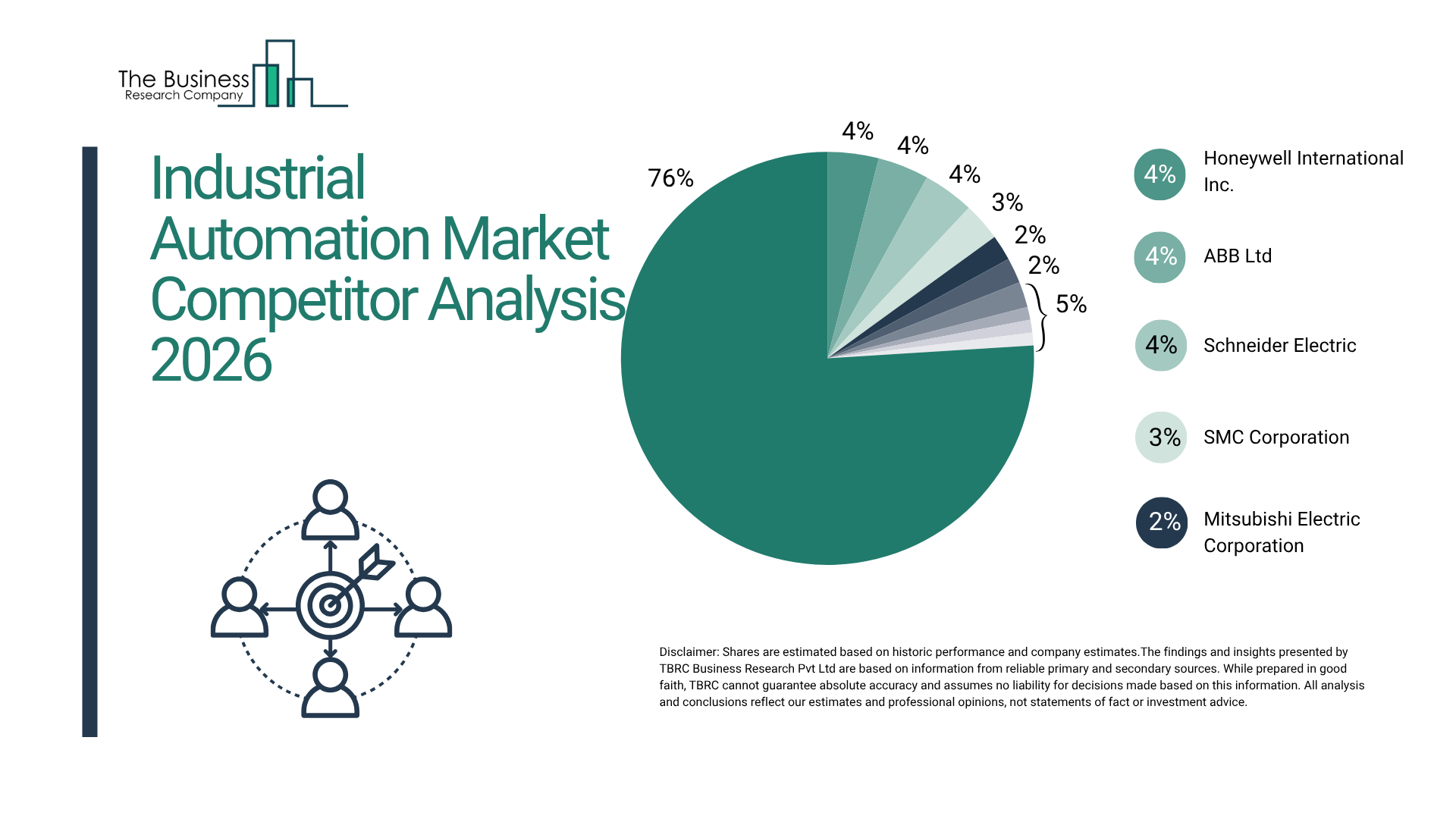
Honeywell International Inc. led global industrial automation sales in 2025 with a 4% share of the market. Its automation and control solutions division offers a wide array of industrial control systems, automation software, sensors, and digital technologies that support manufacturing operations, industrial processes, and smart factory implementations.
In addition to Honeywell, major players dominating the industrial automation market include ABB Ltd, Schneider Electric, SMC Corporation, Mitsubishi Electric Corporation, Rockwell Automation Inc., Yokogawa Electric, Siemens AG, Omron Corporation, and Emerson Electric Co. These companies collectively hold significant market shares thanks to broad automation portfolios, strong industrial partnerships, global distribution networks, and continuous innovation in control systems, robotics, and digital automation.
Market Structure and Competitive Intensity
The industrial automation market demonstrates moderate fragmentation, with the top 10 firms accounting for 24% of total revenue in 2025. This reflects moderate barriers to entry arising from the complexity of automation technologies, integration challenges, and high standards in precision engineering and cybersecurity. The leading companies maintain their positions through diversified product offerings and innovation focused on smart manufacturing, industrial IoT, and automated process optimization. As adoption of these technologies accelerates, strategic alliances, technological breakthroughs, and expansion into new regional markets are expected to further consolidate their competitive edge.
Primary Raw Material Suppliers Supporting the Industrial Automation Industry
Key suppliers of raw materials for the industrial automation market include major semiconductor and electronics companies such as Intel Corporation, NVIDIA Corporation, Texas Instruments Incorporated, Analog Devices Inc., STMicroelectronics N.V., NXP Semiconductors N.V., Infineon Technologies AG, Renesas Electronics Corporation, Microchip Technology Incorporated, Broadcom Inc., and Marvell Technology Inc. Additionally, industry leaders like Rockwell Automation Inc., Schneider Electric SE, Siemens AG, ABB Ltd., Mitsubishi Electric Corporation, Omron Corporation, Honeywell International Inc., Yokogawa Electric Corporation, Keyence Corporation, Cognex Corporation, TE Connectivity Ltd., Vishay Intertechnology Inc., and Murata Manufacturing Co. Ltd. play significant roles in supplying essential components.
Major Wholesalers and Distributors in the Industrial Automation Space
The distribution network for industrial automation products includes prominent wholesalers and distributors such as Arrow Electronics Inc., Avnet Inc., Digi-Key Electronics, Mouser Electronics Inc., Future Electronics Inc., RS Group plc, Farnell Global, TTI Inc., Newark Electronics, Allied Electronics & Automation, WESCO International Inc., Graybar Electric Company Inc., Rexel Group, Sonepar Group, Ingram Micro Inc., Tech Data Corporation, ScanSource Inc., CDW Corporation, Bechtle AG, ALSO Holding AG, Esprinet S.p.A., Redington Limited, Exclusive Networks SA, Macnica Inc., and EET Group A/S. These entities facilitate the global reach of industrial automation technologies.
Leading End Users Driving Demand for Industrial Automation
Industrial automation is heavily utilized by major corporations across automotive, electronics, energy, pharmaceuticals, and consumer goods sectors. Notable end users include Toyota Motor Corporation, Tesla Inc., Volkswagen AG, BMW Group, Ford Motor Company, General Motors Company, Hyundai Motor Company, Mercedes-Benz Group AG, Samsung Electronics Co. Ltd., Apple Inc., Foxconn Technology Group, LG Electronics Inc., Sony Group Corporation, Taiwan Semiconductor Manufacturing Company Limited, Shell plc, Exxon Mobil Corporation, Chevron Corporation, BASF SE, Dow Inc., Pfizer Inc., Johnson & Johnson, Nestlé S.A., Procter & Gamble Company, Unilever PLC, and The Coca-Cola Company.
Competitive Trends Transforming the Industrial Automation Market
AI-powered warehouse automation solutions are revolutionizing the industry by boosting picking accuracy, increasing processing speed, and enabling flexible automation in logistics and warehousing operations. For instance, in March 2025, ABB Ltd. introduced AI-enabled robotic modules specifically designed for fashion and parcel handling. These modules utilize advanced vision systems and AI algorithms to optimize warehouse workflows, enhance accuracy, and enable scalable automation for e-commerce and supply chain sectors.
Strategic Approaches Adopted by Market Players to Maintain Leadership
Companies are concentrating on advancing industrial automation technologies to enhance operational efficiency and productivity. There is a strong focus on leveraging smart automation solutions that improve precision and support informed decision-making. Expanding robotics and automated systems is key to scaling production capabilities, while integrating artificial intelligence technologies helps refine maintenance and manufacturing processes. These strategies collectively help market leaders stay competitive amid rapid technological shifts and increasing demand for intelligent manufacturing solutions.
What’s new in our 2026 market reports:
• Market attractiveness scoring and analysis
• Total addressable market (TAM) analysis
• Company scoring matrix graphics and tables
• Excel dashboards
• Market hotspots infographics
• Key technologies and future trends
• Updated graphics and tables
Learn More About The Business Research Company
The Business Research Company (www.thebusinessresearchcompany.com) is a leading market intelligence firm renowned for its expertise in company, market, and consumer research. We have published over 30,000+ reports across 27 industries and 60+ geographies. Our research is powered by 1,500,000 datasets, extensive secondary research, and exclusive insights from interviews with industry leaders.
We provide continuous and custom research services, offering a range of specialized packages tailored to your needs, including Market Entry Research Package, Competitor Tracking Package, Supplier & Distributor Package and much more.
Disclaimer: Please note that the findings, conclusions and recommendations that TBRC Business Research Pvt Ltd delivers are based on information gathered in good faith from both primary and secondary sources, whose accuracy we are not always in a position to guarantee. As such TBRC Business Research Pvt Ltd can accept no liability whatever for actions taken based on any information that may subsequently prove to be incorrect. Analysis and findings included in TBRC reports and presentations are our estimates, opinions and are not intended as statements of fact or investment guidance.
Contact Us:
The Business Research Company
Americas +1 310-496-7795
Europe +44 7882 955267
Asia & Others +44 7882 955267 & +91 8897263534
Email: marketing@tbrc.info
Follow Us On:
LinkedIn: https://in.linkedin.com/company/the-business-research-company
Oliver Guirdham
The Business Research Company
7882 955267
Visit us on social media:
LinkedIn
Facebook
X
Legal Disclaimer:
EIN Presswire provides this news content “as is” without warranty of any kind. We do not accept any responsibility or liability
for the accuracy, content, images, videos, licenses, completeness, legality, or reliability of the information contained in this
article. If you have any complaints or copyright issues related to this article, kindly contact the author above.

Media gallery